
Build clean. ✅
Continuous Plate Anchor Chair — New "Credit Top Plate as Stiffening Ring" Option (v5796)
What changed
For Continuous Plate anchor chair baseplates, MecaStack now offers two methods for checking the local shell (skirt) stress at the bolt locations:
- Legacy method — Brownell & Young, Process Equipment Design, eqn 10.59. This treats each bolt as if it loads only a local strip of skirt, with no help from neighboring bolts or the continuous top ring.
- New method (RingCr) — Moss, Pressure Vessel Design Manual, Procedure 4-15 with Figure 7-4 Case 5. This treats the top plate plus 16·T_stk of skirt above and below as a continuous composite ring that distributes each bolt load circumferentially through hoop tension and ring bending.
The choice is controlled by a new checkbox in the baseplate input panel labeled "RingCr — Credit Top Plate as Stiffening Ring", located between the Pretension and Number of Bolts inputs.
Why we added it
It is very common for the shell local stress to be exceeding limits and requires the skirt to be increased in thickness. In our 30+ years of designing stacks we have never seen a skirt fail due to local stress and so it has always seemed that the B&Y method was too conservative. That's what has led to this investigation and now change to MecaStack.
The legacy B&Y strip method is conservative, sometimes very conservative, for typical anchor chair geometries. By treating each bolt as an isolated load, it ignores the fact that the top plate, when continuous around the full circumference, is structurally a closed ring. A continuous ring spreads each radial bolt pull around the entire 360° of the section through hoop action, exactly the way a steel band carries the outward thrust of a wooden barrel.
For a typical design, switching from B&Y to the ring-credit method commonly reduces the calculated local shell stress by an order of magnitude and the unity ratio along with it.
This means many existing designs that previously failed (or had marginal unity ratios) with the B&Y method may pass with adequate margin under the more accurate ring-credit method.
How the ring-credit method works
When the option is enabled, MecaStack:
- Builds a composite ring section from the top plate plus a strip of 16·T_stk of skirt above the plate and another strip below the plate (the "below" strip is automatically capped at H_g if it would otherwise extend past the bottom plate).
- Calculates the radial pull per bolt as P_r = P_bolt · a / h, where h is the distance from the mid-plane of the top plate to the mid-plane of the bottom plate, and a is the bolt radial offset from the skirt OD.
- Applies the closed-form ring beam coefficients from Moss Figure 7-4 Case 5 to compute the bending moment and hoop tension force at the two critical sections (at a bolt and between bolts).
- Combines bending and hoop stress on the worst fiber, σ = K_r·P_r·R_m / S + T / A, and compares the maximum to the allowable bending stress based on the skirt's hot yield (Fb_shell).
The full breakdown of the composite ring section properties area, centroidal radius, moment of inertia, section modulus — is shown in tabular form in the calculation output.
What about my existing models?
Backwards-compatible by design:
- Existing models opened in v5796 retain the legacy B&Y method. Your saved unity ratios will not change.
- New models created in v5796+ default to the ring-credit method.
- You can toggle the RingCr checkbox on any model to switch between methods at any time.
If you want to take advantage of the new method on an existing project, simply check the box and re-run the analysis.
When the ring-credit method is appropriate
The ring-credit method is appropriate whenever:
- The baseplate type is Continuous Plate (not segmented).
- The top plate is welded continuously to the skirt (no gaps or splices).
- The number of bolts is sufficient to treat the loading as a discrete-ring problem (typically 4 or more).
It is not appropriate for Segmented Plate chairs, which are checked by an entirely different method
Real World Example
Here is an example of a typical stack using the old versus new criteria. This skirt is 0.375 in [9 mm] thick and is producing a unity stress ratio of 0.627, meaning it is at 62.7% of the allowable stress.

The same exact skirt with the ring-credit option enabled, now produces a Unity Ratio of 0.067 or 6.7% of the allowable stress.
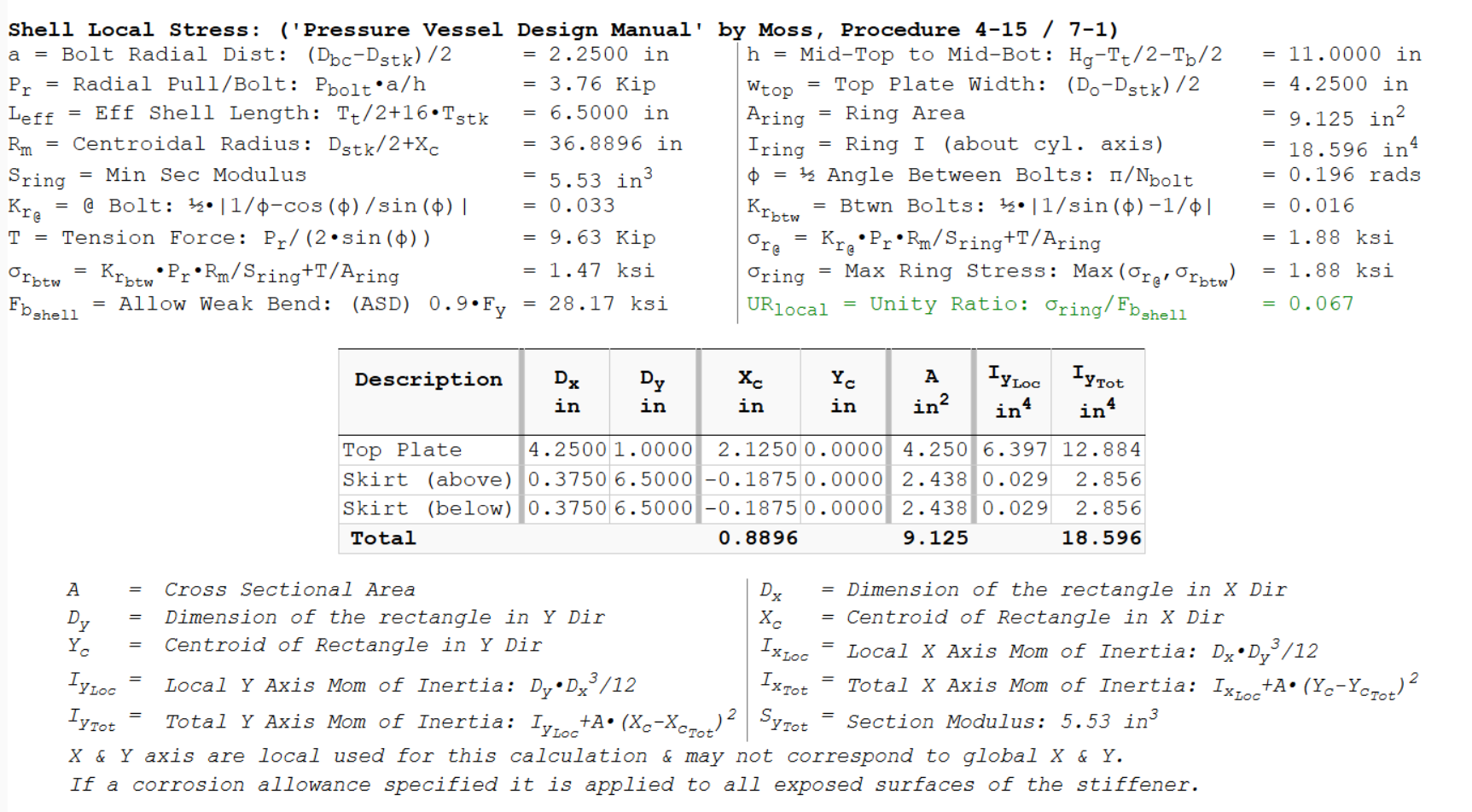
The new method produced a unity stress ratio of about 10.6% of the original value.
References
- Moss, D. R. & Basic, M., Pressure Vessel Design Manual, 4th ed., Procedure 4-15 (Anchor Chair Design — Type 4 Continuous Compression Ring) and Figure 7-4 (Ring Coefficients).
- Brownell, L. E. & Young, E. H., Process Equipment Design, eqn 10.59 (Legacy strip method, retained for backward compatibility).